The Friendly Face of Propaganda: China’s International Media on Social Media

At first glance, Chinese international media outlets may appear to be ordinary news websites, but they are not independent media organizations simply based in China. The Communist Party of China (CPC) strictly controls who is allowed to communicate with the world from China and within China. It decides which topics can be discussed and how. Chinese international media outlets target international audiences. They are state-controlled media that serve the Party in implementing its strategic goals. They disseminate their content not only on websites but also on social media platforms such as Facebook, Instagram, TikTok and X.
Propaganda reframed as Storytelling
In 2013, Xi Jinping first presented the strategy of “Telling China’s Story Well” at a propaganda conference.1 This strategy aims to shape the international perception of China in a “positive” way. However, what sounds harmless and commonplace actually involves influencing the international image of China in accordance with the Party’s views. The goal is to suppress topics that disrupt the image of a peaceful, progressive, and welfare-oriented China. These include the oppression of minorities in Tibet and Xinjiang,2 interference in democratic efforts in Hong Kong,3 and the ongoing threat against independent Taiwan. According to the Party, these issues should not appear in the public image of China. Moreover, the country should consistently be associated with positive attributes such as technological advancement, innovation, beautiful landscapes, cuisine, and culture. The Party’s communication transforms well-founded accusations of human rights violations and other abuses into “misunderstandings” or simply “Western propaganda.” As a logical conclusion to this self-proclaimed problem, there is a demand for so-called “friends of China” who can “tell China’s story well,” understand the unique “Chinese approach,” and “correctly” interpret it. The goal is to have international advocates who can improve China’s image in the world. In this way, the Party can rely on many “friends of China” who spread praise and recognition for the country and the Party, seemingly independently confirming its self-portrayal.4 On the internet this strategy manifests in numerous posts, articles, and videos that present China in a way that is approved by the Party. Enthusiastic influencers share stories of breathtaking landscapes, clean streets, safe transportation, delicious food, and fascinating culture. Often, these formats include a direct comparison with Western countries, in which China always seems to emerge as the winner.
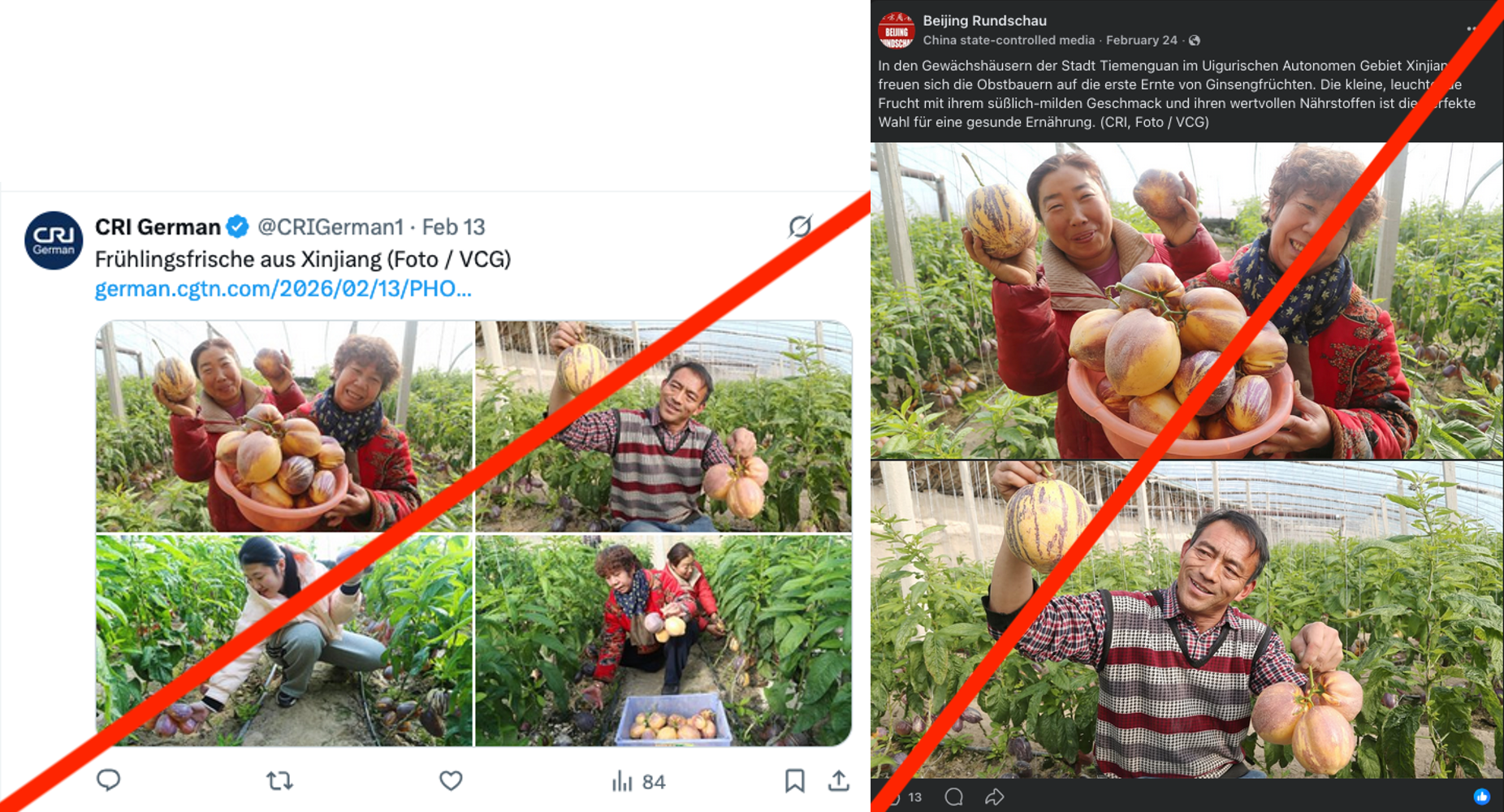
In addition to the general image-building of the country, certain priorities are repeatedly emphasized. The province of Xinjiang, which has gained international notoriety due to human rights abuses against the Uyghurs,5 is barely recognizable in the Party’s communication. State media and influencers repeatedly present it as an exciting travel destination worth exploring. The apparent goal is to dilute and replace the previous association of Xinjiang with the oppression of the Uyghurs. In the future, when international audiences think of Xinjiang, the Party doesn’t want them to think of internment camps, forced labor, and torture, but of exciting travel fever, delicious street food, and charming landscapes. To achieve this, seemingly wholesome impressions from Xinjiang are heavily promoted.
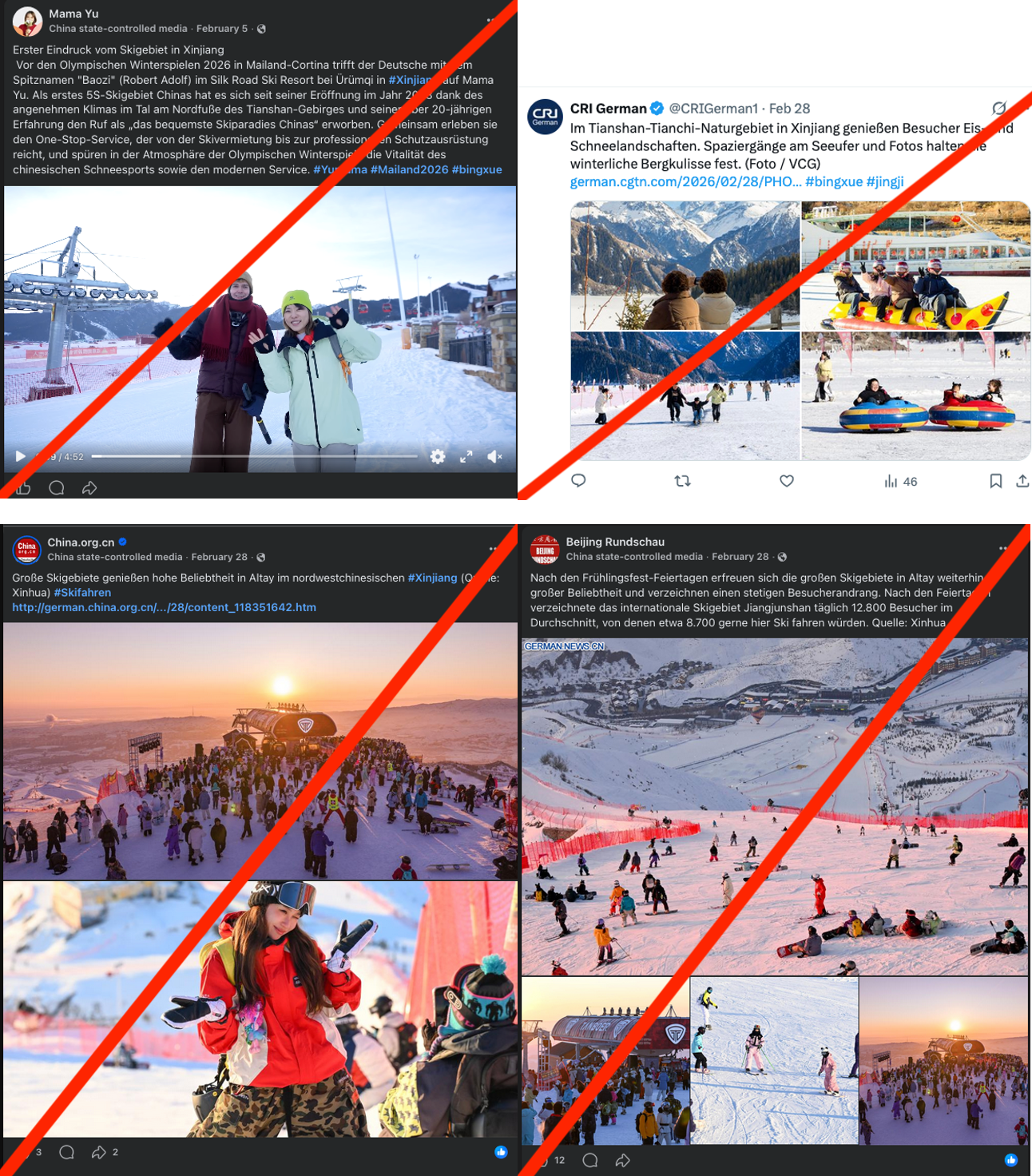
Chinese international media outlets are part of this targeted external communication. They present China as the Party wants it to be seen by the world. The goal of these self-presenting news sites is not to convey facts but to influence the audience in line with the Party’s strategic goals. The CPC seeks international influence to secure its own power and surpass the United States.6 Young, international audiences are considered particularly important for this purpose, and social media is known to be the best way to reach them.7
Free Rein for State-Controlled International Media on Social Media?
The social media presence of state-controlled Chinese international media outlets addresses international users in various languages, including German. While English-language social media profiles are mainly present on TikTok and Instagram, Facebook seems to play the main role in the German-speaking region. Since the escalation of the Ukraine war into an illegal war of aggression in February 2022, state-controlled media on social media have been critically discussed. Media such as RT DE / Russia Today are considered vehicles for information manipulation and are not allowed to be distributed in the EU.8 Similar to the overall debate on illegitimate foreign influence attempts, China also seems to be flying under the radar in the area of state-controlled international media. The websites in question and their social media counterparts are easily accessible in Germany and quite busy spreading pro-China content. So, how do social media platforms deal with this? To answer this question, CeMAS investigated the social media presence of twelve German-speaking Chinese international media outlets9 on Facebook, Instagram, and X for the period of February 2026. During this time, the pages published a total of 2,230 posts in German, including 1,650 on Facebook, 438 on X, and 142 on Instagram.
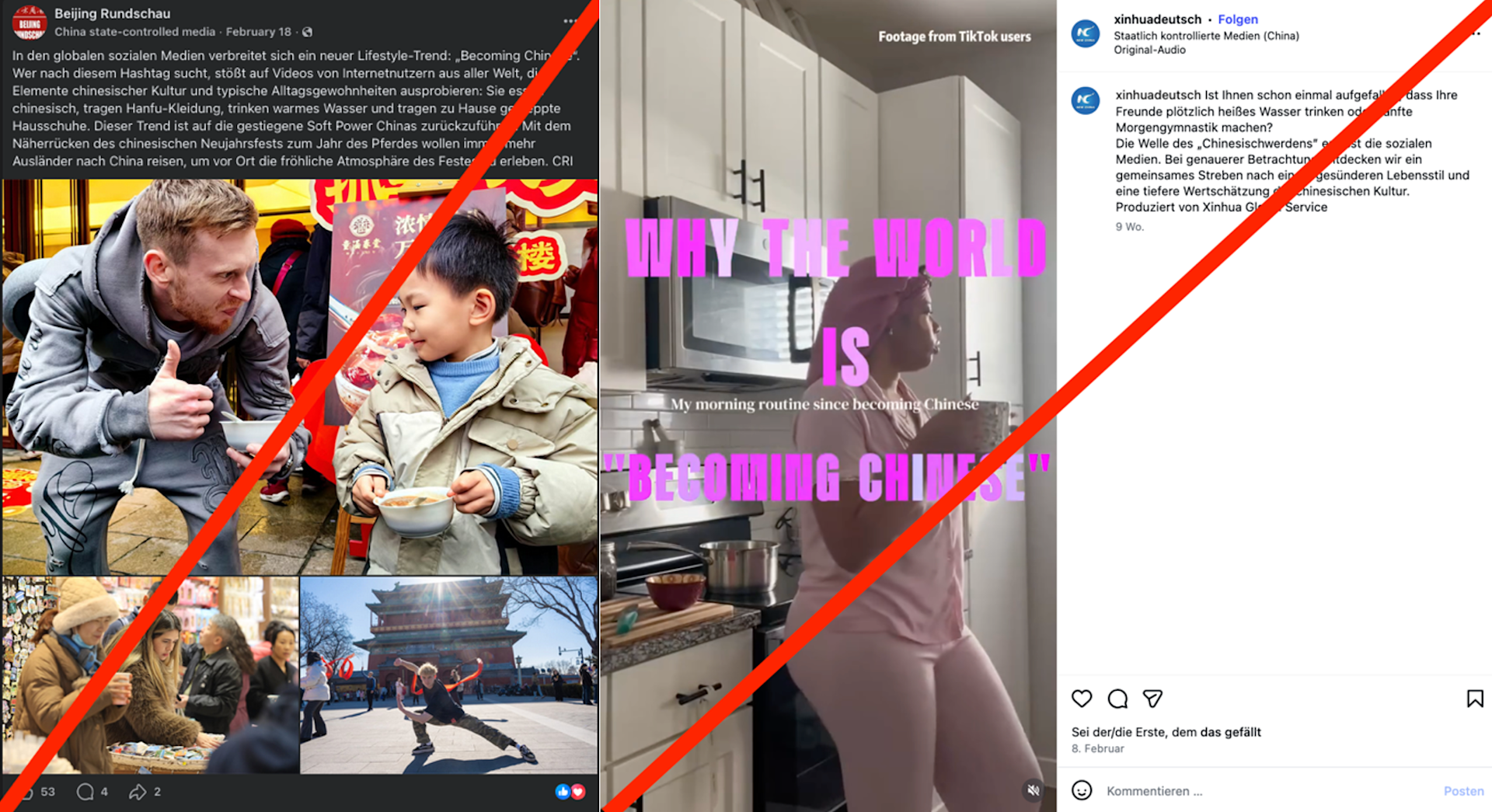
In these posts, China is presented as an open, internationally popular country with advanced technology and a booming economy. In particular, the Spring Festival for the Chinese New Year was actively promoted and repeatedly accompanied by posts that were intended to emphasize China’s international influence. The provinces of Xinjiang and Tibet, where China has demonstrably committed systematic human rights abuses against minorities for years, are presented as picturesque travel destinations with a flourishing culture, tempting cuisine, and happy people. In this way, the dark sides of the authoritarian country are glossed over on social media, and the affected regions are presented in an appealing way to the German audience. The social media platforms allow the dissemination of this content. Their transparency and protection measures vary.
X
Five of the twelve pages had a profile on X, although one appears to have been inactive for some time. The other four pages had a total of over 30,000 followers and published 438 German-language posts on X in February 2026.10 None of the profiles were labeled as state-controlled media.
All twelve of the investigated media outlets had their own German-language Facebook presence. In total, they had 140 million followers11 and posted at least 1,650 German-language posts in February 2026.12 All twelve pages were marked as “state-controlled media (China)” by the platform. Meta states that it assigns this label after careful review and applies a “higher standard of transparency” to the affected pages, “because we believe they combine the influence of a media organization with the backing of a state”.13
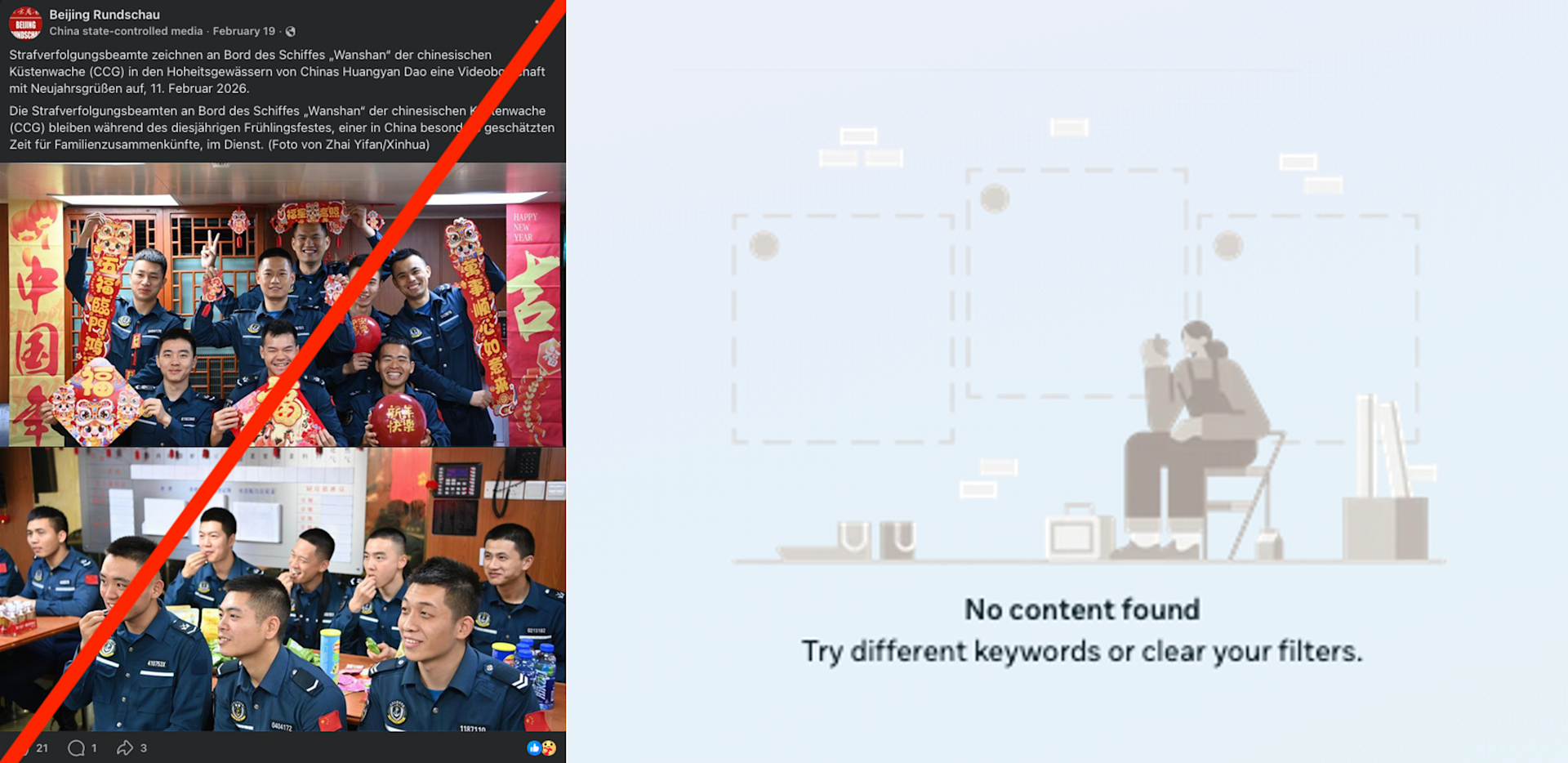
However, CeMAS was unable to track the activity of the investigated pages using Meta Content Library (MCL), Meta’s central transparency tool.14 15 In principle, this tool is supposed to give researchers insight into activities on Meta’s platforms, for example, to identify societal risks such as the spread of disinformation or propaganda and ultimately warn society. The dissemination of state propaganda from China would therefore be highly relevant here. While there were 1,650 German-language posts from February 2026 on the Facebook pages themselves, MCL search yielded no results. The Meta Content Library therefore does not allow for the monitoring of the investigated international media outlets, even though Facebook identifies them as state-controlled and associates this with increased transparency requirements.
According to a response from the MCL support team, the missing content is not due to a technical error. Rather, content from China, North Korea, South Korea, and Togo is excluded from access via the MCL.16 Posts from admins from the excluded zones are not displayed in MCL, for which no explanation was given. The 1,650 posts that could be manually accessed via Facebook but were not found in the MCL must therefore come from admins from the excluded zones. This way, China can ensure the dissemination of its own propaganda to international audiences with a simple organizational trick while at the same time evading systematic researcher insight into their activity. All of which would be in full compliance with the terms and conditions of the platform used.
CeMAS informed Meta about the inadequate transparency of the Meta Content Library with regard to state-controlled state media from China on April 2, 2026. As of this article’s completion on April 20, 2026, no response had been received. A review of the missing data in the MCL yielded the same result as before.
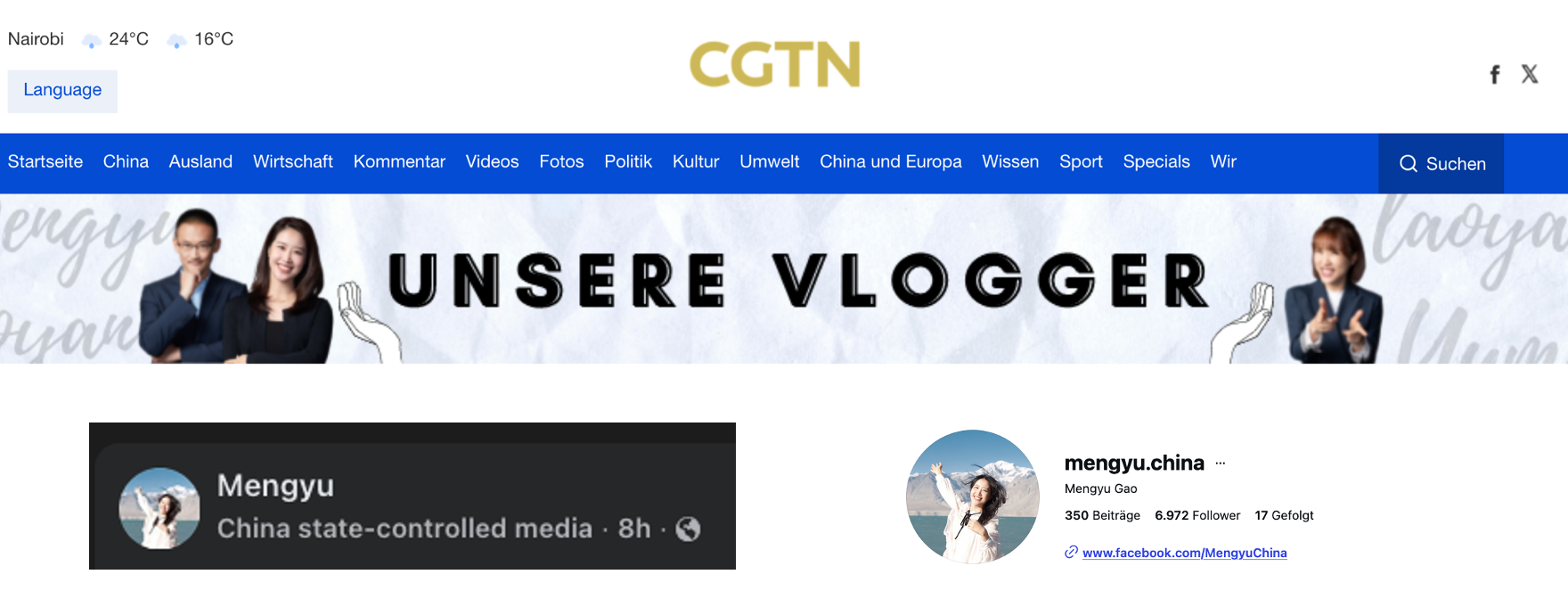
Of the twelve investigated media outlets or vloggers, only Xinhua Deutsch and the CGTN vlogger Mengyu also operated German-language Instagram profiles. Xinhua is China’s state news agency, but it also has offices outside of China. CGTN is a state-controlled Chinese international television broadcaster who also employs Vloggers. They create content for the broadcaster and also run their own channels.
The Instagram profiles of Xinhua Deutsch and Mengyu published 142 German-language posts in February 2026, with Xinhua using both German-language and English-language video material with German captions. In combination, the two pages reach over 6,000 followers.17 Only Xinhua was identified as state-controlled media. The page of the CGTN vlogger Mengyu does not have this label, although her Facebook page, which is also linked in the profile, is appropriately identified as state-controlled media. MCL documentation of their content is inadequate as well. Content from Xinhua Deutsch can be viewed, but not downloaded. This is probably due to the profile‘s low three-digit number of followers, as the MCL does not allow for post downloads from smaller profiles and pages for data protection reasons.18 Mengyu’s page and content cannot be found in the MCL at all.
Conclusion
Chinese state-controlled international media outlets are trying to influence a German-speaking audience through social media. Their aim is to have China associated exclusively with positive attributes, as a technological pioneer and an increasing influence on international developments. Flagrant human rights abuses are to be diverted from the focus of attention. The goal is to influence public opinion in line with the Communist Party of China. Social Media platforms such as Facebook, Instagram, and X, which are not accessible in China itself,19 are used as vehicles for propaganda.
The platforms allow the instrumentalization of their services and fall short of expectations in terms of transparency and user protection. On Instagram and X, there is a lack of systematic labeling of the sometimes very active pages and profiles. In particular, on Facebook, it is clear that Meta is not keeping its own transparency promises.
1 China Media Project (2021, 16, April). Telling China’s Story Well. https://chinamediaproject.org/the_ccp_dictionary/telling-chinas-story-well/
2 Human Rights Watch (2026, 4. Februar). China: Wachsende Repression – auch über Grenzen hinweg. https://www.hrw.org/de/news/2026/02/04/china-wachsende-repression-auch-ueber-grenzen-hinweg
3 Fulda, Andreas (2025, 7. Oktober). Hongkong im Schatten des Sicherheitsgesetzes. https://www.bpb.de/themen/asien/china/571498/hongkong-im-schatten-des-sicherheitsgesetzes/
4 Hamilton, C. & Ohlberg, M. (2022). Die lautlose Eroberung. Wie China westliche Demokratien unterwandert und die Welt neu ordnet. Pantheon.
5 Giesen, C., Obermaier, F., Obermayer, B., Stahl, S. & Chen, J. (2026, 16. April). Vor Schloss Neuschwanstein setzte er sich ab, nun enthüllt er Chinas Verbrechen. SPIEGEL.de. https://www.spiegel.de/ausland/china-polizist-auf-der-flucht-vor-schloss-neuschwanstein-setzte-er-sich-ab-nun-enthuellt-er-pekings-verbrechen-a-99dc7584-e913-4069-a695-56e6261b5d58
6 Hamilton, C. & Ohlberg, M. (2022). Die lautlose Eroberung. Wie China westliche Demokratien unterwandert und die Welt neu ordnet. Pantheon.
7 Herald, S.W., Beauchamp-Mustafaga, N. & Hornung, J. W. (2021). Chinese disinformation efforts on social media. RAND Corporation.
8 Rat der Europäischen Union (2022, 2. März). EU verhängt Sanktionen gegen die Sendetätigkeiten der staatseigenen Medien RT/ Russia Today und Sputnik in der EU. https://www.consilium.europa.eu/de/press/press-releases/2022/03/02/eu-imposes-sanctions-on-state-owned-outlets-rtrussia-today-and-sputnik-s-broadcasting-in-the-eu/
9 The study included China’s state-controlled international media outlets, as well as affiliated vloggers who publish content in German. The following were analyzed: Beijing Rundschau, China Radio International (CRI), CRI Culture, Tibet Online Deutsch, Peoples Daily Online (German), Dialog China Deutschland, China Internet Information Center (German), CGTN (German), Xinhua (German), Meng Yu, Yan Wie, and Mama Yu.
10 Retrieved April 10, 2026.
11 The follower numbers were retrieved from the pages themselves. However, comparatively low post engagement raises doubts about the authenticity of the high follower numbers.
12 Retrieved March 12 and 16, 2026.
13 https://www.facebook.com/help/767411547028573/?cms_id=767411547028573&query=state%20media
14 Meta Platforms, Inc., (März, 2026). Meta Content Library version v6.0 https://doi.org/10.48680/meta.metacontentlibrary.6.0
15 Meta describes the MCL as a web-based tool that allows researchers to explore and understand data from Facebook and Instagram. The MCL does this by providing a comprehensive, visual, and searchable collection of publicly available content. Those who want to investigate the activity of Facebook pages can capture them in producer lists, display their activity in dashboards, or search directly for content from these pages. For data protection reasons, content from smaller accounts is excluded from the downloadable dataset, which is operationalized through a follower threshold of 15,000.
16 https://developers.facebook.com/docs/content-library-and-api/content-library#geographic-scope
17 Retrieved March 31st, 2026
18 https://developers.facebook.com/docs/content-library-and-api/content-library